

If you have talked to a marketing agency lately, you have probably heard a new acronym. GEO. AEO. AISO. LLMO. Each one promises to get your business found in ChatGPT, Gemini, Copilot and Google’s AI Overviews, and each one comes with someone insisting it is the only correct name.
So which one is real? A research project from content agency Fractl and the trade publication Search Engine Land set out to answer that by looking at what marketers actually recognize, search for, talk about and hire for. Their answer is reassuring for business owners: the labels are multiplying, but the work underneath them is still SEO.
Here is a plain-English summary of what they found and what it means for your marketing.
Why the name matters at all
AI search is no longer a side channel. In an earlier Fractl and Search Engine Land survey of 2,000 consumers, 82% said AI-powered search was more helpful than traditional search. When that many people are getting answers from AI tools, businesses naturally want a word for “making sure we show up there.”
The trouble is that agencies and consultants have each picked a different word. That makes it hard to compare proposals, write job descriptions or even know whether two vendors are offering the same thing.
The terms, decoded
Before the findings, a quick glossary:
- SEO (search engine optimization): improving your website so it ranks in search engines like Google.
- GEO (generative engine optimization): getting your business mentioned and cited in answers from generative AI tools like ChatGPT and Gemini.
- AEO (answer engine optimization): structuring content so it gets pulled into direct answers, such as Google’s AI Overviews and featured snippets.
- AISO or AI SEO (AI search optimization): a broad label for SEO that accounts for AI search alongside traditional results.
- LLMO (large language model optimization): a narrower term focused on how large language models learn about and describe brands.
- SXO (search experience optimization): combining SEO with the on-site experience, so visitors who arrive from search actually convert.
What marketers recognize vs. what they actually use
The researchers surveyed 342 marketing professionals. Most recognized the newer terms, led by GEO at 84%. But when asked which single term they personally use for this work, the answers split: 42% picked GEO, 16% AI SEO, and 14% each chose AEO or plain SEO. Everything else, including LLMO and SXO, was recognized by fewer than half of respondents.
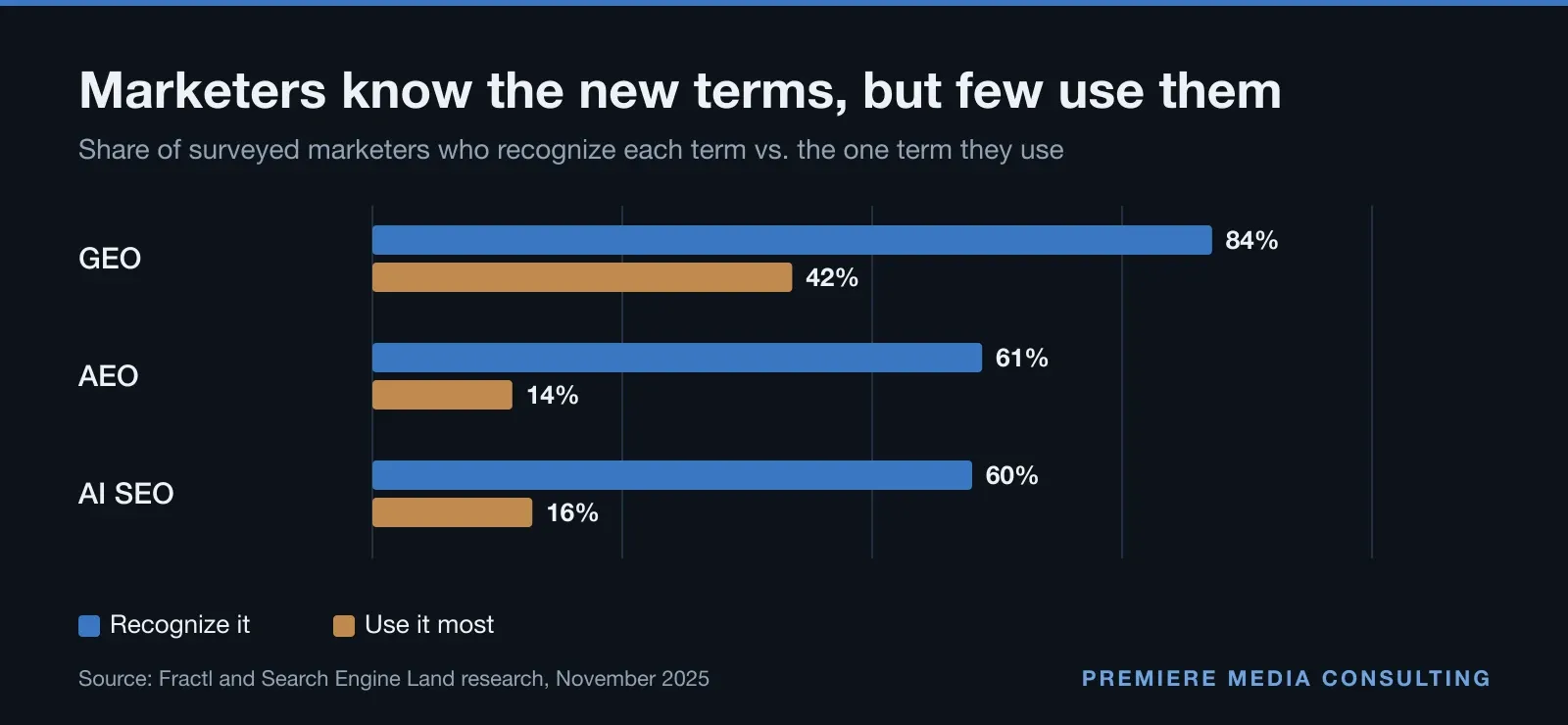
In other words, the industry knows the vocabulary but has not settled on it. Search Engine Land’s editorial director described it as a transitional moment: the work is mostly the same as SEO, though not a perfect overlap, and organic search still drives far more traffic than AI tools do today.
Which terms are gaining momentum
Looking at Google search interest, the researchers measured how fast each term grew from one quarter to the next in late 2025. “Answer search optimization” (ASO) grew the fastest at 152%, followed by GEO at 121%, AIO at 99% and AISO at 90%.
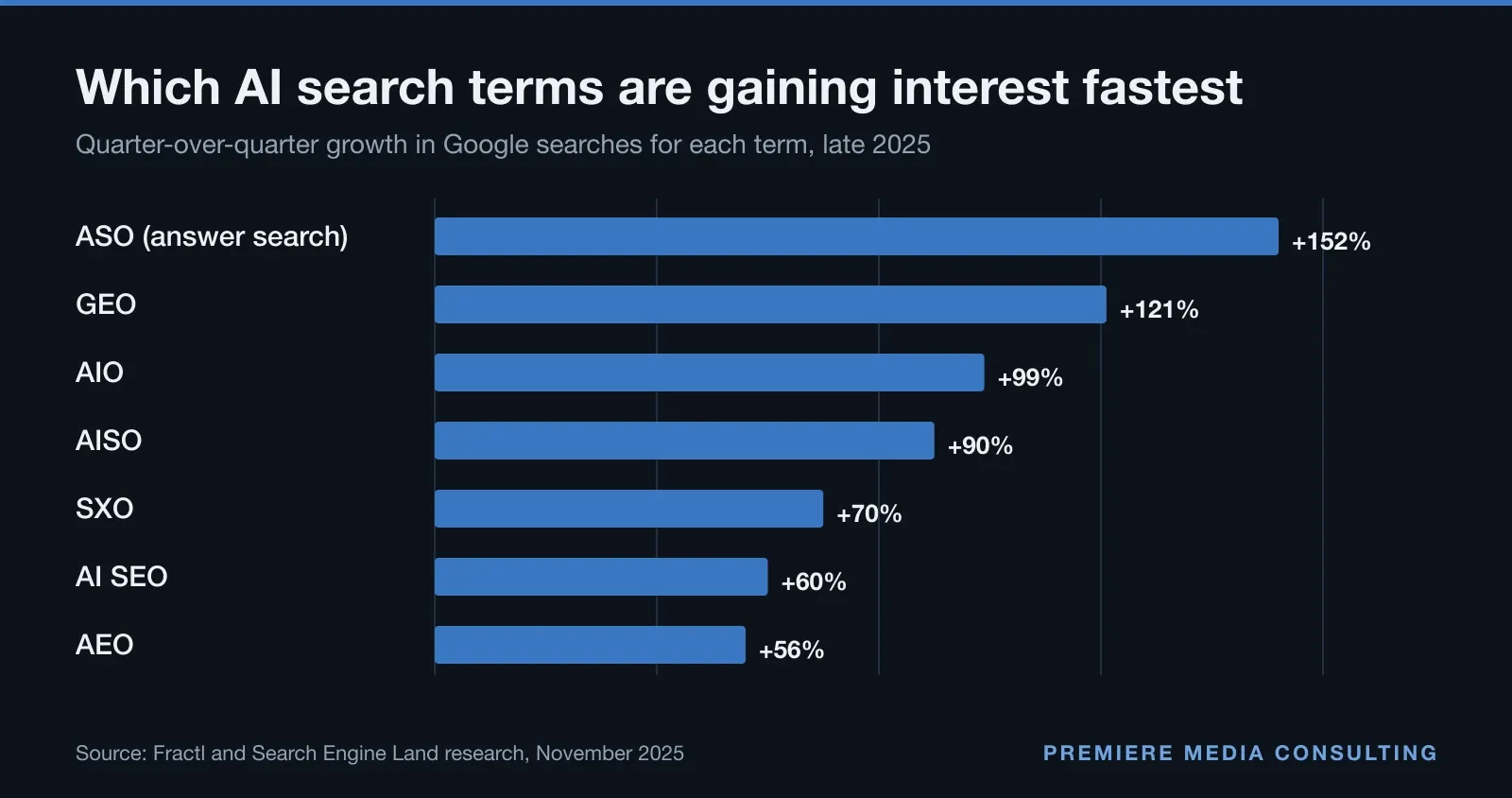
One caution if you see “ASO” in a proposal: the same acronym has meant app store optimization for years. Ask the vendor to spell it out.
Plain language wins on social media
The team analyzed 6,400 LinkedIn posts and 3,350 Reddit threads to see how people felt about each term. The warmest reactions went to the most literal labels. “SEO” was positive in 90% of LinkedIn posts, and “AI SEO” was positive in 96% of Reddit threads. “AISO” did well on LinkedIn but was viewed far more skeptically on Reddit.
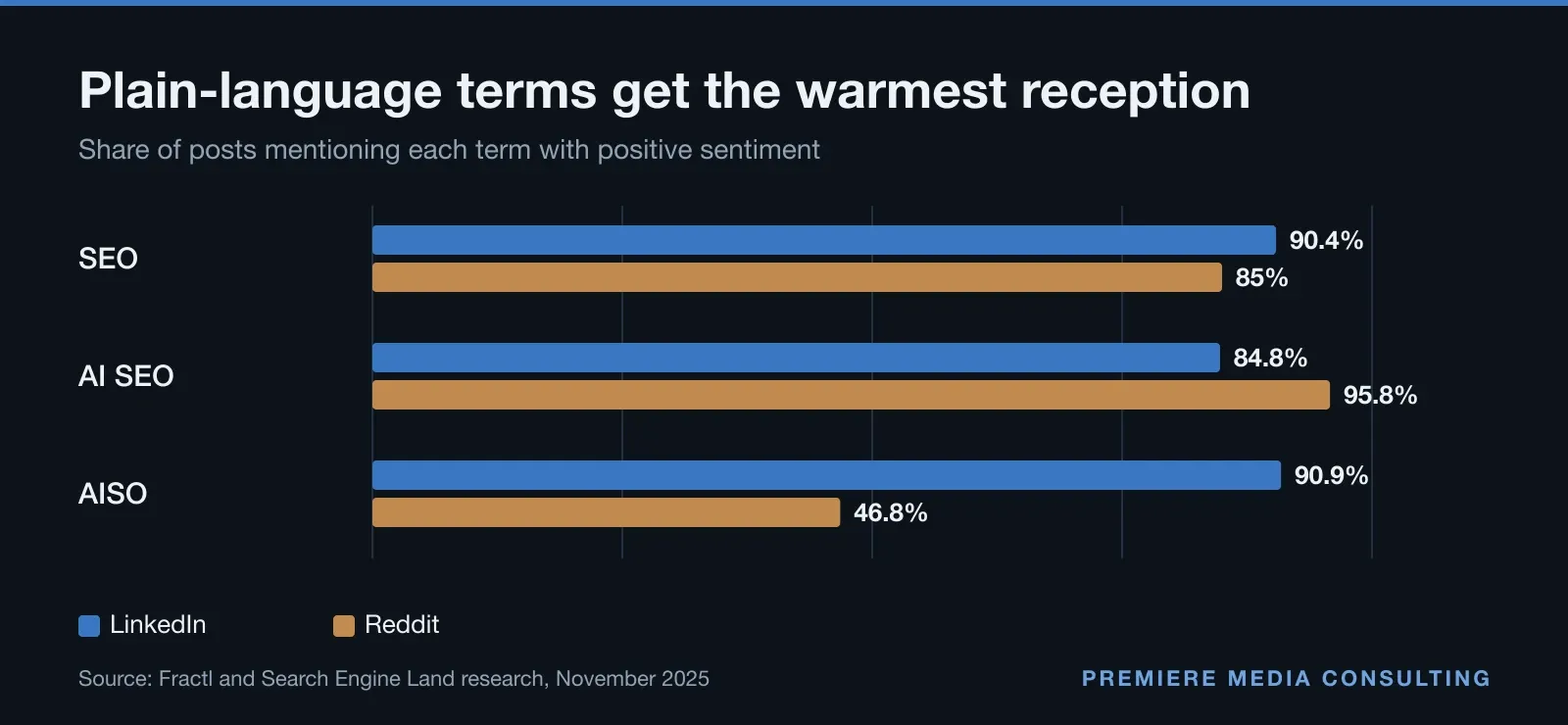
The takeaway is that practitioners see AI search as the next chapter of SEO, not a replacement for it. Clever acronyms get attention, but plain words earn trust.
What employers are actually hiring for
The most telling data came from job listings. Across more than 33,000 U.S. postings on Indeed, AISO appeared in 11,001 of them, more than SEO, AEO, GEO and LLMO combined. Employers are not hiring “GEO managers.” They are hiring SEO professionals who also understand how AI tools find, summarize and recommend businesses.
That matches what we see with our own clients. The skills that get you into AI answers are the same ones that get you onto page one: helpful content, a fast and well-structured website, accurate business information and a strong reputation across the web.
What this means for your business
You do not need to pick the “right” acronym. You need a clear plan that covers both traditional search and AI answers. Here is how to think about it:
- Keep SEO as the foundation. Rankings, technical health and quality content still feed every AI tool. A site that search engines cannot crawl or trust will not be cited by AI either.
- Write content that answers real questions. Clear, direct answers to the questions your customers ask are what AI tools quote. This is the heart of AEO and GEO.
- Build your reputation beyond your own site. AI assistants lean on reviews, directory listings, industry mentions and press coverage to decide who to recommend.
- Keep your business details consistent. Your name, address, phone number and services should match everywhere, from your Google Business Profile to industry directories.
- Ask vendors to define their terms. If an agency sells “GEO” or “AISO,” ask what specific work is included and how they will measure results. Good answers sound a lot like good SEO.
The bottom line
SEO is not dead, and the new labels are not just hype. AI search is a real shift in how people find businesses, and it adds new places where you need to show up. But the playbook is familiar: publish genuinely useful content, keep your website fast and well built, and earn mentions and reviews where your customers spend their time. Do that consistently and you will be visible whatever the industry ends up calling it.
Research summarized from “SEO, GEO, or ASO? What to call the new era of brand visibility in AI” by Fractl and Search Engine Land (November 2025). Charts redrawn by Premiere Media Consulting from the published data.
Want to know how your business shows up in AI search? We can review your website, content and online reputation and give you a clear plan that covers Google and AI assistants alike. Get a free quote and we will reply within 24 hours.
Want help putting this into practice?
Get a free, no-obligation plan for your website and marketing within 24 hours.